E-Business Suite
Stay on Oracle EBS or migrate to the cloud: how to decide
Staying on Oracle EBS, moving it to OCI or migrating to Oracle Fusion Cloud are three different routes. What matters in each, and why the costliest isn't always best.
· 5 min read
Almost every conversation about Oracle EBS ends with the same question: is it time to migrate? It is a reasonable question, but an incomplete one. Migrate to what, and in exchange for what, are the questions that really organize the decision.
There are three distinct routes, not two. Stay where you are, move the infrastructure without touching the ERP, or migrate completely to another product. Each solves a different problem and costs differently. Treating them as a single all-or-nothing decision is the most common way to overspend.
This question usually reaches executive leadership by two paths. One is the budget: someone notices that EBS has been on the same spending line for years and wants to know whether it is worth reviewing. The other is an incident: a close that took longer than usual, a ticket nobody resolved in time. Neither of them, on its own, says which route to take. Separating the three options is what does that.
The three routes: stay, move to OCI or migrate to Cloud
Sustain EBS where it is
This means sustaining EBS where it is today, with organized functional and technical support. Nothing about the system changes; what changes is who looks after it and how. It is the right route when the real problem is a lack of people who know the system, not the system itself, and it is also the one that requires the least new budget: it is about organizing what already exists, not buying something different.
Move the infrastructure to OCI
This means moving the infrastructure to Oracle Cloud Infrastructure, OCI, which is Oracle's public cloud for compute, storage and databases. The ERP stays exactly the same: the screens, the reports, the customizations. Only where the server lives changes, and Oracle documents specific paths for making that move with backup and provisioning processes already defined.
Migrate completely to Oracle Fusion Cloud
This means migrating completely to Oracle Fusion Cloud, which is a different product, with a different architecture and a different way of working inside the system. It is a re-implementation project, not a relocation: processes that get redefined, data that gets migrated and users who learn a different interface.
The three routes are not mutually exclusive over time. It is common to sustain the system for a couple of years while support is organized, then move the infrastructure to OCI to stop investing in your own servers, and only then evaluate a full migration when the business truly calls for it. Treating it as a progression, instead of a single final decision, reduces the risk of each step.
What matters in the decision
Four variables organize almost every case we have seen.
- Age and condition of the system: how many customizations it has, how well documented they are and whether anyone in the company can explain them today.
- Available support: whether the internal team or the current provider still knows the system, or whether every change has become slow because nobody wants to touch it.
- Infrastructure cost: how much it costs today to sustain your own servers versus what it would cost in OCI, and whether those savings justify the project on their own.
- Real business need: whether there is a business reason, such as expansion into several countries or consolidation of units, that EBS no longer handles well.
The first three are resolved with a technical assessment. The fourth is answered by the business, not by IT, and it is usually the one that actually decides whether migrating makes sense.
Why migrating isn't always the right answer
Migrating from EBS to Oracle Fusion Cloud is a complete re-implementation project: processes that get redefined, data that gets migrated, users who are trained again. It makes sense when the business case justifies it. It doesn't when the problem is something else and a migration just moves it to a new system, with the same lack of people who know it.
It is a mistake we see often: a company with a support and documentation problem decides to migrate, and ends up with the same problem in a different product, plus the project invoice on top. The assessment exists precisely to avoid that mistake before signing anything.
What it means to sustain EBS with team continuity
Sustaining it well doesn't mean leaving the system on autopilot. It means regular functional and technical support, orderly database administration, patching that doesn't turn each one into an ordeal, and documentation of whatever is touched, so that knowledge doesn't live only in the heads of one or two people.
When that exists, EBS keeps doing its job: it closes the books, controls inventory, runs purchasing. The decision to migrate stops being an urgency and becomes an option, which is exactly where it should be.
Where to start
With an assessment of the real state of your EBS: which customizations it has, how current support is, and how far your current infrastructure is from what it would cost in OCI. With that in hand, the three routes stop being a gamble and become a comparison with numbers.
Tell us which version of EBS you run, how many companies and countries you consolidate, and what currently takes longer than it should.
How we can help
Facing something similar?
Tell us which system you run and what it can't do for you today. The first conversation is about understanding your situation.
Request an assessment
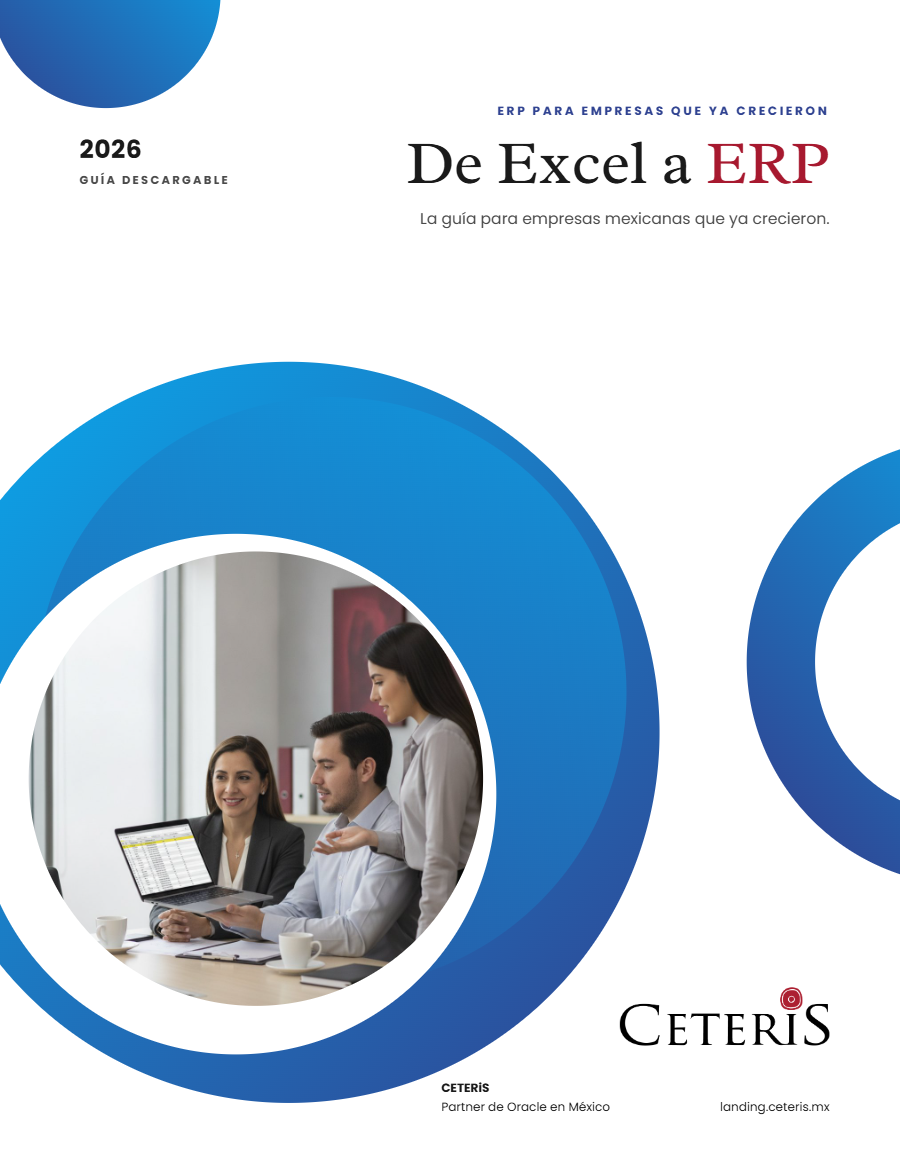
Free guide · 24 pages · In Spanish
From Excel to ERP: how to tell if it's time
What we'd tell you in a first assessment meeting, in writing: how to know whether you need an ERP, what it costs in estimated ranges and how to migrate without disrupting operations. Currently available in Spanish; English edition coming soon.
- The 7 signs you've outgrown spreadsheets
- What an ERP costs and what drives the price
- The 5 most expensive mistakes
- A checklist to decide whether it's time