E-Business Suite
What is Oracle E-Business Suite, and why it is still running in 2026
What Oracle E-Business Suite is, why it is still running in 2026, and what options a Mexican company has to sustain it before deciding whether to migrate.
· 5 min read
Oracle E-Business Suite has spent decades supporting the operations of large companies in Mexico. It closes the books, controls inventory, runs purchasing and invoices customers. And it is still doing so in 2026, even though the public conversation about ERP has moved almost entirely to the cloud.
That is why it is worth explaining what it is, why so many companies keep it, and what options exist for those who run it today. Migration appears in this article, but at the end, which is where it usually falls in real life.
What Oracle E-Business Suite is
E-Business Suite, or EBS, is the Oracle ERP that is installed on your own servers or in a contracted data center. It covers finance, procurement, inventory, manufacturing, projects and order management, among other modules that are activated depending on the operation.

At many companies it is known simply as “Oracle” or “Oracle Apps.” The version Oracle maintains today is 12.2, and it continues to receive functional, security and compliance updates.
Its distinguishing trait compared with a cloud ERP is control. The company decides when to update, what to customize and how to integrate. That control explains much of its staying power and also much of its risk.
Why it is still running in 2026
The short answer is that it works. Behind it are concrete reasons that repeat at almost every company that consults us.

- Customizations accumulated over years that reflect how the company really operates, and that no standard product ships with.
- Integrations with plant systems, warehouses, banks and customers that were built on EBS and that nobody wants to retest today.
- Mexican tax localization already solved: CFDI (Mexican e-invoice), payment complements, electronic accounting filings and DIOT (Mexican VAT report on third-party transactions) running for years.
- The cost and risk of replacing a system that supports daily operations, when the business has other investment priorities.
- Oracle maintains the product within its support policy and continues to publish patches and enhancements.
Behind these reasons are rational decisions: companies investing where the return is clear and sustaining what already delivers. Treating them as inertia is misreading the situation.
Where the real risk is
Software ages slowly and knowledge ages fast. That mismatch is the problem we find most often at companies that run EBS.
The team that implemented the system has left or is about to retire. The partners who knew it moved on to the cloud and stopped training EBS consultants. Every small change becomes a project and every incident takes longer than it should.
The symptoms are recognizable from the executive suite, without ever opening the system.
- Nobody wants to touch the system because nobody knows what breaks if something moves.
- Oracle patches pile up unapplied, because applying them is frightening.
- The documentation for the customizations lives in the heads of one or two people.
- The current vendor takes weeks to resolve tickets that used to take days.
- Every tax change from the SAT (Mexico's tax authority) is handled outside the system, with spreadsheets.
When two or more of these symptoms appear, the root is usually a lack of people who know the system, more than the system itself. And that can be solved without changing ERP.
Sustain, move the infrastructure, or migrate
Faced with that situation there are three paths, and almost nobody frames them as separate options. It is worth doing so, because the effort and cost of each are very different.
Sustain EBS where it is
This is the most common path and the least visible. Functional and technical support, database administration, orderly patching and documentation of everything that gets touched. It solves the knowledge gap without changing anything in the system.
Move EBS to Oracle Cloud Infrastructure
This is the middle option few people consider. The ERP stays the same and only where it lives changes. You gain in infrastructure operations and postpone the big project until the business calls for it.
Migrate to Oracle Fusion Cloud ERP
This is the next step, and it applies when the business case justifies it: growth into several countries, consolidation of units, or a need for capabilities EBS will no longer receive. When that moment arrives, we know what breaks in a migration because we have seen them break. Until then, sustaining well is a legitimate decision.
What to review before deciding
Any of the three paths starts the same way: with an honest snapshot of the system's real state. These are the questions that organize that snapshot.
- What customizations exist, who built them, and which are still in use?
- Which patches and updates are pending, and since when?
- How is the database doing in size, performance and backups?
- Which integrations depend on EBS, and what happens if one fails?
- How are tax changes handled today, inside or outside the system?
- How many people at the company can explain how the close works?
At CETERiS we complement EBS with our own development, including 12 proprietary add-ons on Oracle for tax and operational requirements in Mexico. We develop with Oracle APEX, backed by Oracle's Cloud Native Applications Expertise, and it is the tool we use to build those extensions.
Where to start
With an assessment of your EBS's real state. It is the starting point we suggest, because it defines the scope before you commit to an investment, and you keep the document even if you decide not to continue. Tell us which version you run, how many entities and countries you consolidate, and what takes longer than it should today.
How we can help
Facing something similar?
Tell us which system you run and what it can't do for you today. The first conversation is about understanding your situation.
Request an assessment
Free guide · 24 pages · In Spanish
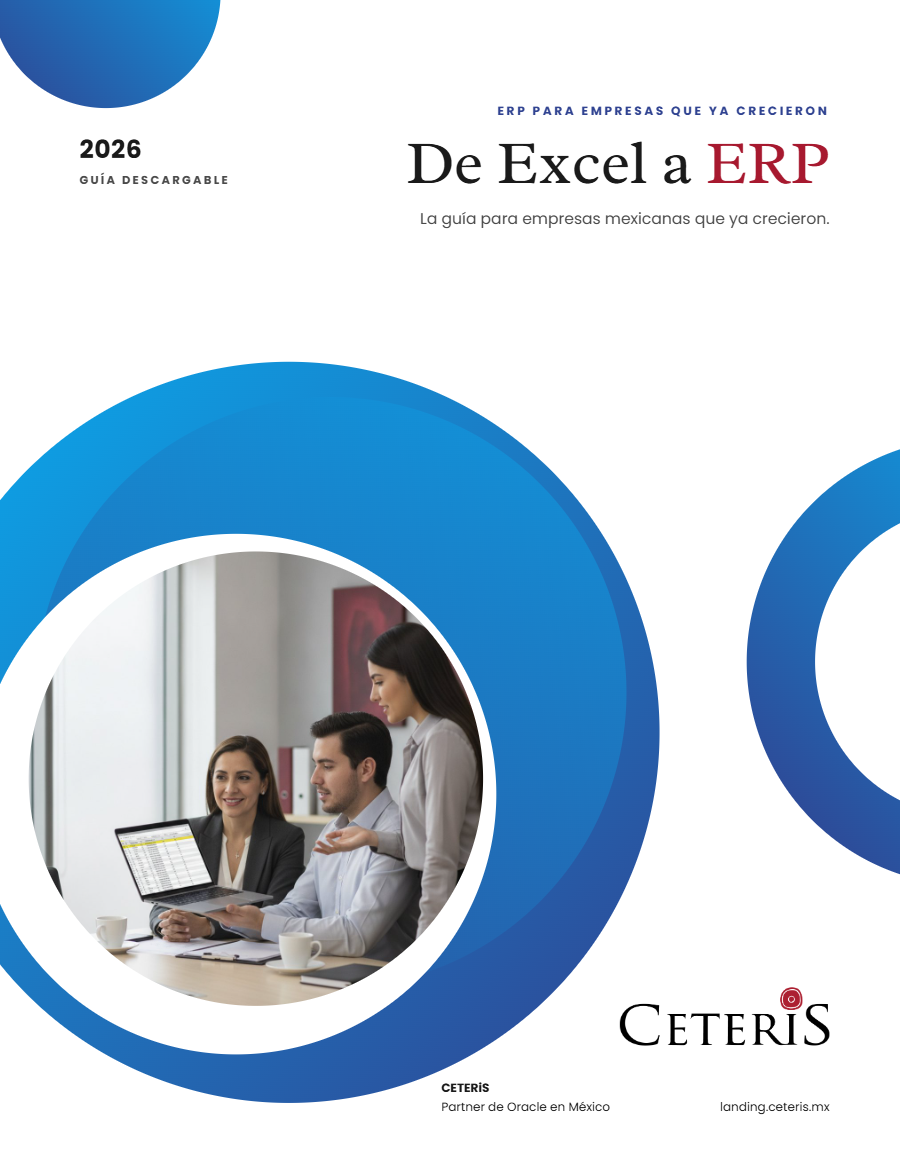
From Excel to ERP: how to tell if it's time
What we'd tell you in a first assessment meeting, in writing: how to know whether you need an ERP, what it costs in estimated ranges and how to migrate without disrupting operations. Currently available in Spanish; English edition coming soon.
- The 7 signs you've outgrown spreadsheets
- What an ERP costs and what drives the price
- The 5 most expensive mistakes
- A checklist to decide whether it's time