Oracle Fusion Cloud and Redwood
ERP for manufacturing in Oracle Cloud: from sales order to work order
How Oracle Manufacturing models a plant: work definitions, work orders, discrete and process manufacturing, and how production is costed.
· 4 min read
No two plants are alike, and an ERP built to distribute product isn't enough on its own to make it. In manufacturing, the system has to say what is produced, with which components, in what sequence, on which equipment, and how much it costs.
This article explains how Oracle Manufacturing, part of Oracle Fusion Cloud SCM, models all this, and which decisions are yours to make. It is a description of the product based on Oracle's documentation, not a promise about any particular project.
What it covers
Oracle describes it as core discrete and process manufacturing capabilities in the cloud, to set up, manage, execute and cost production. It covers in-house manufacturing of standard products, make-to-order of configured products (in discrete manufacturing), contract manufacturing, and operations outsourced to a supplier. Discrete and process manufacturing can run in the same plant.
- Discrete: products counted by the unit, such as assemblies.
- Flow: production on dedicated lines, with schedules by line.
- Process: batch production with multiple outputs, including co-products and by-products.
Step one: describe the plant
Before producing anything, the system needs to know how the plant is organized. According to Oracle, the data includes:
- The plant, which is the organization where manufacturing data is defined and processes are run.
- The production calendar, with workdays, shifts and exceptions.
- Work areas and work centers, such as departments or production lines where an operation is performed.
- Production resources, whether equipment or labor, with their rates, which are defined in Cost Management.
- Standard operations, a library of operations that can be reused in work definitions.
This work belongs to engineering and operations before it belongs to IT. The ERP only reflects how your plant is organized, and if that organization isn't clear, the system won't clarify it.
Step two: the work definition
The work definition describes how a product is made and serves as the template for work orders. In discrete manufacturing, it combines the item structure (the bill of materials) and its routing in a single view, with operations, materials and resources. If the product has subassemblies that are also manufactured, each one has its own definition. In process manufacturing, the definition includes operations, outputs, materials and resources, and works by batch quantity.
A product can have more than one. The primary one is what the system uses as a reference to create standard orders, and alternates cover variations in operations, components or resources. There are dedicated definitions for products that are reworked or transformed into another of higher or lower specification, although Oracle notes that rework and transformation are currently supported only in discrete manufacturing.
Step three: from sale to work order
The work order is the document that gives authority to manufacture a specific product: what, how, how many and when. Oracle documents that, in discrete manufacturing, the system can create it as supply for a sales order when the item is made to order, when the product is configured or when it is made under contract. That is the link between sales and the plant.
Supervisors can also create orders directly, and in discrete manufacturing there are orders without a work definition for activities such as prototypes. Predefined serial numbers can be assigned, components can be substituted and, in process manufacturing, the batch can be scaled by input or output quantity.
In process manufacturing, Oracle also documents that you can record the completion of co-products and by-products, and schedule the order forward, backward or from an intermediate point, without capacity constraints.
Step four: execute and monitor
The documentation describes indicators for the supervisor, by plant, work area or work center: orders, rework, open exceptions, scheduled versus actual operations, work in process and inspections. They are designed for use on a tablet, right next to the line. Shop floor data can record operation transactions automatically.
For material availability, in process manufacturing the documentation mentions availability rules and a shortage analysis by order, with the option of replacing components with recommended substitutes. It is the kind of feature that keeps you from discovering on the line that an input is missing.
For regulated industries, Oracle states that electronic signatures can be captured and electronic records generated, and that the system keeps an audit trail of changes to work definitions, orders and standard operations.
Step five: cost the production
Oracle Manufacturing works together with Cost Management to cost production. There is a work-in-process valuation report to review and reconcile at period close, with analysis by released, completed or canceled order. For finance, this means the cost of what is on the plant floor comes out of the same system as the accounting.
Decisions that are yours to make
- Is your operation discrete, flow, process or a mix?
- Are your bills of materials and routings clean today, or do they live in files and in someone's memory?
- Who maintains the work definitions when an engineering change happens? Oracle offers to coordinate those changes through automation or notification.
- How will shop floor progress be recorded: manual entry or automatic data from the line?
- Which operations are outsourced, and how are they controlled?
CETERiS is an Oracle Partner. If you are evaluating manufacturing in Oracle Cloud and want to talk through your case, tell us how your plant produces and we will tell you plainly whether it is something we can support. You can learn more about the platform at www.ceteris.mx/oracle-fusion/.
Sources
How we can help
Facing something similar?
Tell us which system you run and what it can't do for you today. The first conversation is about understanding your situation.
Request an assessmentMore posts

Inventory and warehouse management in Oracle SCM: from book stock to real visibility
Procurement in Oracle Cloud: what it solves and how it connects to your financial ERP
Oracle Fusion Cloud modules that almost no one uses to their full potential
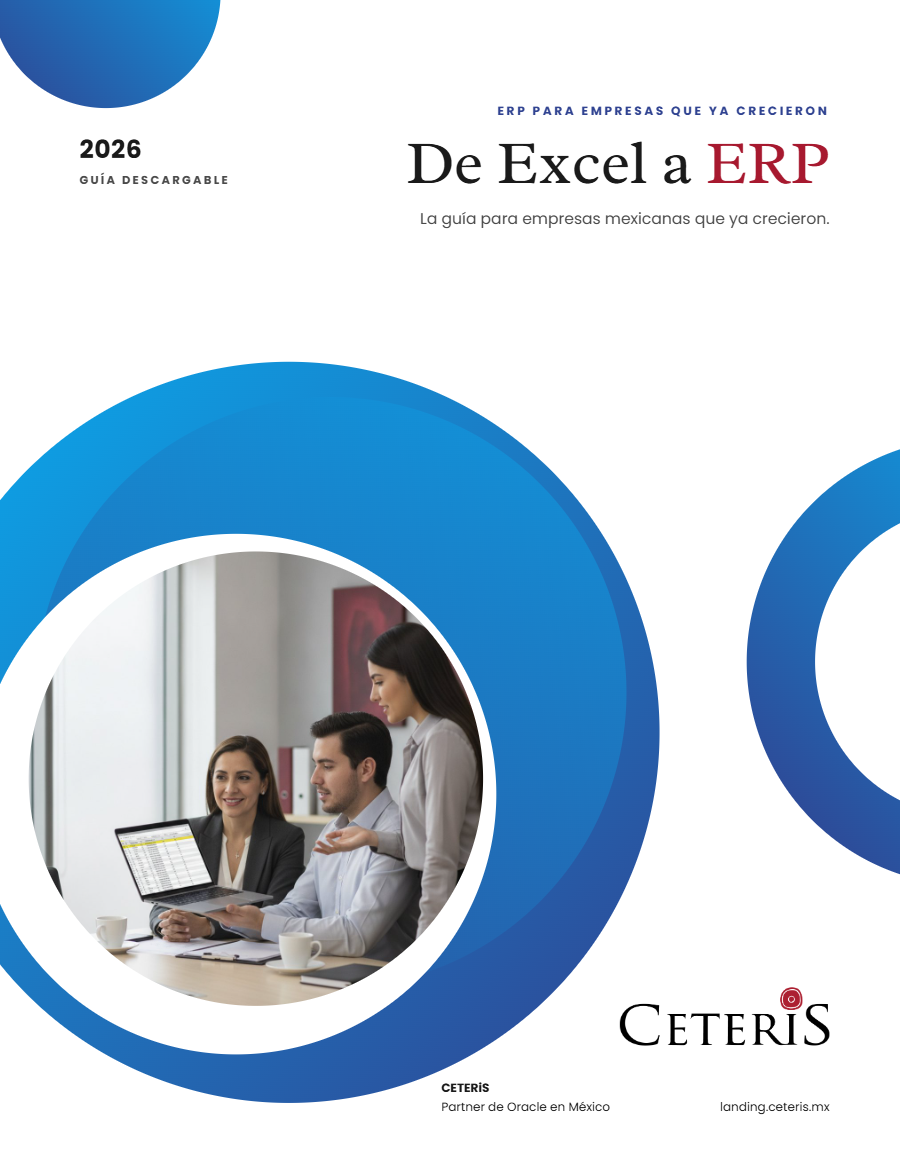
Free guide · 24 pages · In Spanish
From Excel to ERP: how to tell if it's time
What we'd tell you in a first assessment meeting, in writing: how to know whether you need an ERP, what it costs in estimated ranges and how to migrate without disrupting operations. Currently available in Spanish; English edition coming soon.
- The 7 signs you've outgrown spreadsheets
- What an ERP costs and what drives the price
- The 5 most expensive mistakes
- A checklist to decide whether it's time