Oracle Fusion Cloud and Redwood
Procurement in Oracle Cloud: what it solves and how it connects to your financial ERP
Oracle Procurement covers requisition to payment. What it solves for finance, how it reconciles with accounts payable, and what to define before turning it on.
· 5 min read
At many companies, the purchasing cycle lives only halfway in the ERP. Accounting is in the system, but requisitions are requested by email, purchase orders are built in a spreadsheet, and the supplier invoice reaches accounts payable without anyone confirming what was received.
For leadership, that has a name: spend committed without control. You pay for what was not received, buy outside contract, and at close the liability is rebuilt by hand.
Oracle Procurement is the part of Oracle Fusion Cloud that brings order to that path, from requisition to payment. This article explains what it includes, how it connects to the financial ERP, and what decisions to make before turning it on.
What Oracle Procurement includes
Oracle organizes procurement into two subscriptions, and understanding the difference is the first decision.
Self Service Procurement handles the requisition: employees request what they need through catalogs and guided buying, and each request goes through approval workflows that keep it within policy and current contracts. It is the entry point for bringing order to who requests what and who authorizes it.
Procurement covers the rest of the supplier cycle:
- Purchasing, which manages purchase orders and receipts.
- Procurement Contracts, which ties contracts to negotiations, orders and invoices.
- Sourcing, for inviting suppliers to a negotiation, comparing bids and recommending who to buy from.
- Supplier portal, a self-service space where suppliers register, view orders, submit information and track their invoices.
- Supplier Qualification Management, which qualifies suppliers with questionnaires and scoring rules, and alerts you when a qualification is about to expire.
You do not have to buy everything at once. If the problem is in how purchases are requested and approved, start with Self Service Procurement. If it is in orders, contracts or the supplier relationship, the starting point is Procurement. Many companies end up with both, because full control runs from requisition to payment.
The path of a purchase, from requisition to payment
Seen from the operation, the cycle has four moments that belong in the same system:
- The requisition: someone needs something and requests it, with approval.
- The purchase order: it is formalized with the supplier, with price, quantity and terms.
- The receipt: confirmation that what was ordered arrived.
- The invoice and payment: accounts payable compares what was invoiced against what was ordered and received, and only then pays.
When all four moments live in Oracle Cloud, each step leaves a record linked to the previous one. Whoever approves, whoever receives and whoever pays see the same document, not a different version in each department.
How it connects to the financial ERP
The most important point of contact is the invoice. Accounts payable compares it against the purchase order and, depending on the rule you define, against the receipt as well:
- Two-way: order and invoice must match within tolerance.
- Three-way: order, receipt and invoice must match.
- Four-way: the quantity accepted after an inspection is added.
If something does not match, the invoice is held until it is resolved, and the system can notify the requester when a receipt still needs to be confirmed, one of the most common causes of stalled payments.
There is also an accounting effect. If expense is recognized at receipt, the liability is recorded from that moment and any price difference against the invoice is identified without waiting for the close. If the company uses periodic costing, reconciling against the receipt is what keeps inventory cost accurate.
For finance, the consequence is concrete: liability and expense are recognized by a rule defined in the system, not by a manual reconciliation at close.
In Mexico, suppliers are also validated against the SAT
Beyond internal control, operating in Mexico requires validating the supplier. Checking that a supplier does not appear on the SAT (Mexico's tax authority) lists of presumed non-existent transactions under Article 69-B of the Federal Tax Code (blacklisted suppliers) before onboarding or paying it, and confirming that the CFDI (Mexican e-invoice) received matches the order and what was received, protects the tax deduction. These controls are built into the purchasing flow through localization add-ons, instead of remaining a separate lookup.
Where you see the difference
- Fewer invoices paid without support, because reconciliation is part of the flow and not a later review.
- A shorter close, because goods received but not invoiced can be queried in the system instead of reconstructed.
- A single supplier master, instead of one in purchasing and another in accounting.
- Traceability: in an audit, every payment is tied to an order, an approval and a receipt.
None of these benefits comes just from turning on the module. They depend on your company's purchasing process being defined and on someone maintaining it.
What to decide before turning it on
- What percentage of purchases goes through a formal order today, and how much is bought with the invoice already in hand?
- Who approves what, and up to what amount? Approval workflows are configured with that rule.
- Do you pay against the order or against the receipt? That decision sets the level of reconciliation and the accounting treatment.
- How many active suppliers do you have, and how many are duplicated or missing complete tax data?
- Which purchases are goods, which are services and which are recurring? Each type is configured differently.
The answers show where to start and which subscription you need: Self Service Procurement when the disorder is in requisitions and approvals, and Procurement when it is in orders, contracts, suppliers or invoice reconciliation, which is where accounts payable's manual work is concentrated.
How to approach it with Oracle Cloud already live
If you already run the financial ERP on Oracle Fusion Cloud, turning on procurement is an expansion, not a project from scratch. You review the current configuration, define the purchasing and approval rules, clean up the supplier master, and test the full cycle before opening it to users.
At CETERiS, Oracle awarded us the Procurement Oracle Expertise for Latin America, the specialization in the purchasing, ordering and payment flow in Oracle Cloud, and we add the tax localization each country requires. If you want to review how your purchasing cycle looks today and what to turn on first, schedule a conversation with our team or learn more about the platform at www.ceteris.mx/oracle-fusion/.
How we can help
Facing something similar?
Tell us which system you run and what it can't do for you today. The first conversation is about understanding your situation.
Request an assessmentMore posts

Inventory and warehouse management in Oracle SCM: from book stock to real visibility
Oracle Fusion Cloud modules that almost no one uses to their full potential
Oracle Fusion Cloud ERP: what it includes and what size of company it's for
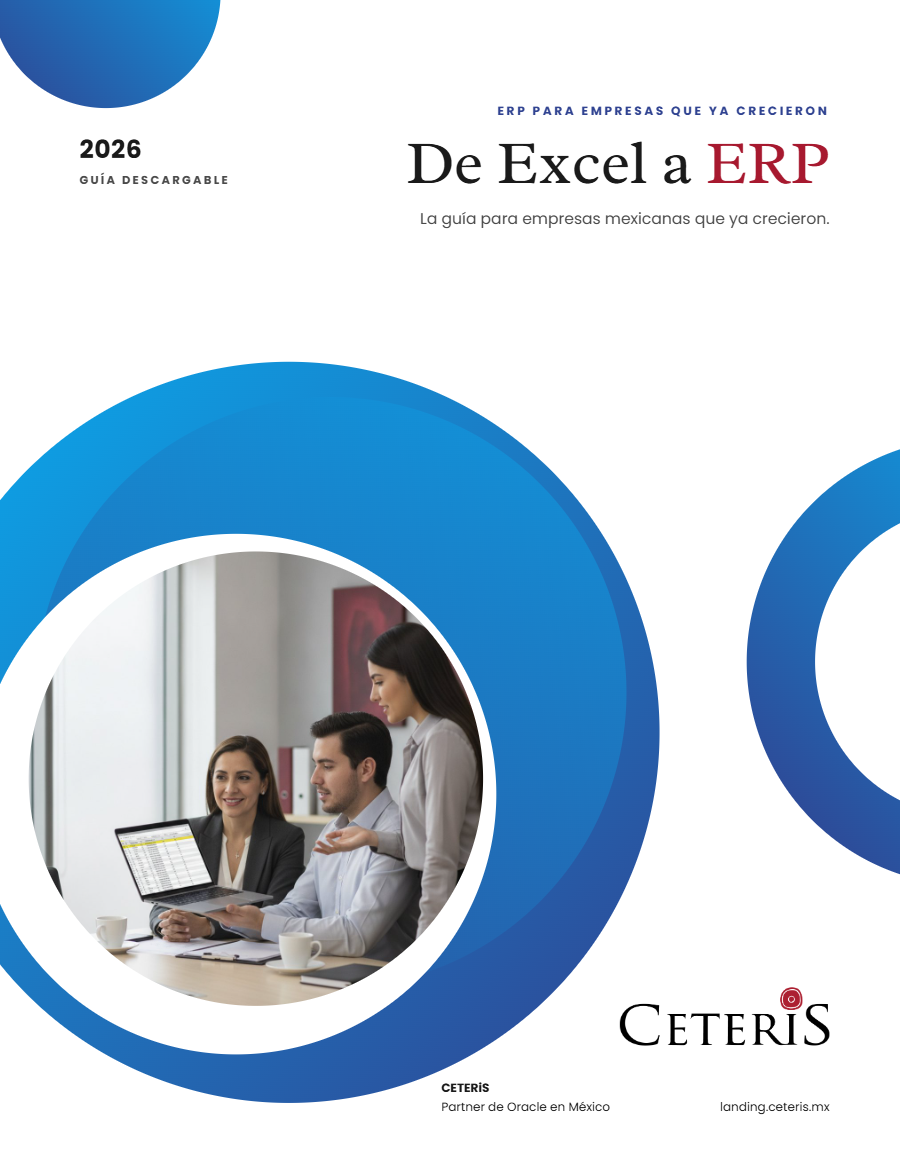
Free guide · 24 pages · In Spanish
From Excel to ERP: how to tell if it's time
What we'd tell you in a first assessment meeting, in writing: how to know whether you need an ERP, what it costs in estimated ranges and how to migrate without disrupting operations. Currently available in Spanish; English edition coming soon.
- The 7 signs you've outgrown spreadsheets
- What an ERP costs and what drives the price
- The 5 most expensive mistakes
- A checklist to decide whether it's time