ERP Project Recovery
Your ERP won't go live: five common causes
Five common reasons an ERP project doesn't reach go-live: scope, vendor turnover, unmigrated data, and a lack of business validation.
· 4 min read
Some ERP projects have gone months without a go-live date, and no one says it out loud. People keep talking about pending configuration, one more test, a module that still needs adjusting. No one says the full sentence: this project is not going live.
There is no single cause. But after seeing many stalled projects, the same five repeat under different company names. And they almost never show up alone: they tend to come combined, which makes it harder for anyone inside the project to see the whole pattern while living it.
Scope that grew out of control
The project started with a defined scope: this many modules, this many companies, this many integrations. By the third meeting, a report that wasn't in the plan had been added, an approval rule someone asked for, an integration with a system no one had mentioned.
Each addition on its own seems reasonable. Together, they move the go-live date without anyone having made that decision explicitly. The project didn't slip all at once; it slipped in increments that no one added up in time.
The vendor's team changed midway
The consultant who gathered the requirements is no longer the one configuring the system. The new team inherits incomplete documentation, decisions that were never put in writing, and a learning curve paid for with the customer's calendar.
When this happens more than once in the same project, the pattern becomes hard to hide: each consultant handoff adds weeks that weren't in the original plan, and the customer ends up explaining its own business a second or third time to new people.
Data that never finished migrating properly
Data migration is usually the least visible part of the project and the one that holds it up most. Duplicate customer lists, product codes with three different versions, historical balances no one dares to reconcile because no one understands where the difference came from.
Going live with data like that doesn't solve the problem; it moves it into a new and more expensive system. That's why many projects stall right before the final cutover: someone, rightly, refuses to sign off on go-live with those numbers.
The common blind spot is that data cleanup is almost never assigned to someone with dedicated time. It gets spread among the same people who are already running day-to-day operations, and that work, which is not small, advances at the speed of whatever is left over between one urgent task and the next.
No one in the company validates before going live
The vendor tests the system against the requirements it gathered. But requirements and real operations don't always match, and the only way to find that gap is for someone from the business to test the system doing their real work, not a generic test case.
When that validation doesn't go through the department that will use the system every day, the project can look finished in the demo and fail in the first real week of operation.
This gets worse when the system has more than one internal owner. If finance requested the project but operations is the one who will use it every day, and operations never sat down to validate because no one formally convened them, any late finding is discovered after go-live, when fixing it costs more and puts more pressure on the team.
The curve every project goes through, and when it stops being normal
Every change process pushes operational performance down before it recovers. That is predictable and is not, by itself, an alarm signal: any team learning a new system works slower in the first weeks.
What is an alarm signal is when the curve doesn't climb back. If, months past the expected date, the team is still as slow as at the start, or if the project hasn't even reached its go-live date to begin that curve, one of the five causes above is holding back recovery, and it's worth naming it instead of continuing to wait for it to resolve itself.
What to do if your project shows one of these signs today
None of these five causes is solved by putting more pressure on the same team that has gone months without delivering a date. They are solved with an assessment that says, specifically, which of the five is happening in your case and how far go-live really is.
- If the scope grew, re-bound it in writing before configuring any further.
- If the team changed, document what the current team knows before losing anyone else.
- If the data isn't clean, decide what gets migrated, what gets cleaned up, and what gets discarded.
- If no one from the business has validated, that testing has to happen before any new date is set.
None of these four steps requires you to decide up front between rescuing what exists and reimplementing from scratch. That decision comes later, and it should be made with data from the five causes once identified, not with the accumulated frustration of months without a date.
If you recognize one or more of these signs in your project, the rescue self-assessment is the first step: ten questions and an immediate result on how serious the point where it stalled is.
How we can help
Facing something similar?
Tell us which system you run and what it can't do for you today. The first conversation is about understanding your situation.
Request an assessment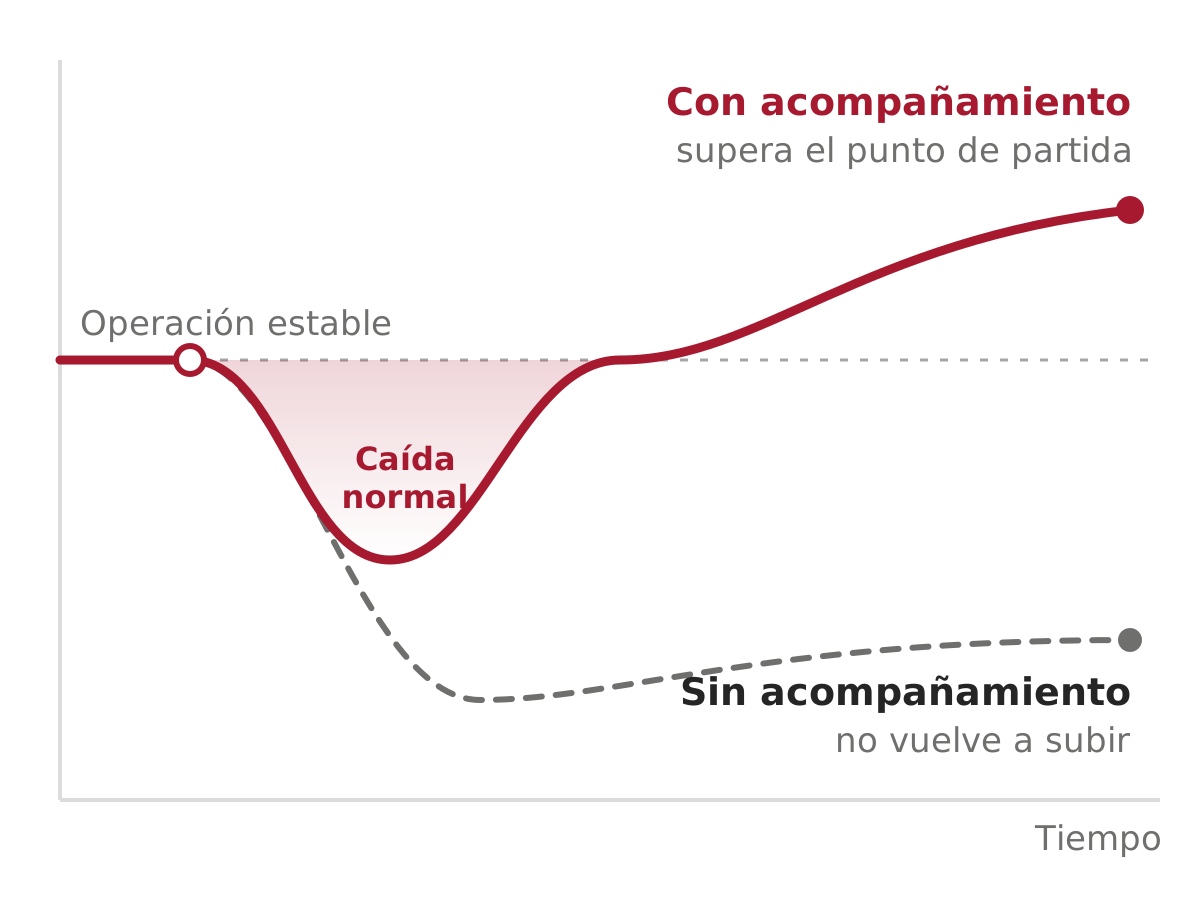


Free guide · 24 pages · In Spanish
From Excel to ERP: how to tell if it's time
What we'd tell you in a first assessment meeting, in writing: how to know whether you need an ERP, what it costs in estimated ranges and how to migrate without disrupting operations. Currently available in Spanish; English edition coming soon.
- The 7 signs you've outgrown spreadsheets
- What an ERP costs and what drives the price
- The 5 most expensive mistakes
- A checklist to decide whether it's time