NetSuite and Choosing an ERP
Oracle ERP: Fusion Cloud, NetSuite or E-Business Suite, which one fits your company?
Fusion Cloud ERP, NetSuite and E-Business Suite: how to tell Oracle's ERP products apart and which one fits your company's size and operations.
· 5 min read
Someone on your team says “we need Oracle's ERP,” and the conversation moves on as if everyone meant the same thing. They rarely do. Behind that phrase are three different products, each with its own architecture, licensing and update cadence, and each demanding a different level of effort to run.
Three Oracle ERPs, three types of company
Oracle Fusion Cloud ERP, Oracle NetSuite and Oracle E-Business Suite are the three Oracle ERPs we work with at CETERiS. None is the newer version of another: moving from one to another is a new implementation, not an upgrade.
A quick way to place them before getting into the details:
- Fusion Cloud ERP: cloud-based, built for operations with multiple legal entities, multiple countries and financial consolidation.
- NetSuite: cloud-based, built for the company that has outgrown spreadsheets and keeps growing.
- E-Business Suite: on your own or hosted servers, built for complex operations that need to decide when the system is updated and how it is hosted.
Oracle Fusion Cloud ERP: the large company with complex operations
Oracle Fusion Cloud ERP is a SaaS suite: Oracle runs the infrastructure and releases quarterly updates, with the same version for every customer. It brings finance and accounting (general ledger, payables and receivables, fixed assets, treasury and expenses), procurement and project management together on a single platform. It is complemented by Oracle Fusion Cloud SCM, which covers manufacturing, supply chain planning, order management, inventory execution, logistics and product lifecycle.
It makes sense when the complexity is in the structure: several legal entities, plants or distribution centers in more than one state, a presence in more than one country, or financial processes that consolidate across business units. If you close the month today by manually pulling together figures from several companies in the same group, or if your operation depends on a supply chain with manufacturing and planning, you are in this product's territory.
NetSuite: the cloud ERP for the fast-growing company
NetSuite is a cloud-native ERP: every customer runs the same version, and Oracle releases two updates a year. For your company, that means no servers, patches or version upgrades to manage, and your customizations carry over through each update, so you never get stuck on an old version.
Its core covers finance and accounting, inventory, order management and procurement on a single database, and it expands with modules for manufacturing, demand planning, warehouses, planning and budgeting, CRM, e-commerce and professional services. With the OneWorld edition, it runs multiple subsidiaries, currencies and languages in one system, with financial consolidation. It is the natural ERP for the company that no longer fits in spreadsheets or an accounting package and plans to grow in sales, locations or countries without changing platforms at every stage.
One nuance is worth knowing from the start: a subscription does not leave you with a working system. A configuration project is needed to adapt it to your processes. We explain this in more detail in the article “What NetSuite is and how it works.”
E-Business Suite: the suite you control from your own infrastructure
E-Business Suite, or EBS, is Oracle's suite that installs on servers owned by the company, by a provider or on Oracle Cloud Infrastructure (OCI). It spans finance (general ledger, payables and receivables, fixed assets and treasury), procurement, order management, inventory and warehouses, discrete and process manufacturing, planning, projects and asset management. Unlike the two cloud options, here you decide when to apply each update and how the system is hosted. In exchange, your team or your partner handles the infrastructure, patching and security.
Oracle maintains release 12.2 under a continuous innovation model and commits to Premier Support through at least 2037, with an annual review to extend it.
Staying on EBS is a valid decision, as long as it is a decision and not inertia. It is worth reviewing how many customizations you have accumulated, who understands them, and whether the system still keeps pace with your operation.
How to tell which one fits your company
None of these four questions decides on its own, but together they almost always make the direction clear.
Size
It matters less for revenue than for structure: how many legal entities, countries and business units you have to report on. NetSuite, with OneWorld, handles multiple subsidiaries and their consolidation; Fusion Cloud ERP is justified when, beyond the number of entities, transaction volume, the depth of financial processes and supply chain complexity also weigh in.
Complexity
Ask yourself how much of your operation fits standard processes. If your finance, procurement and projects work like those of any company in your industry, a cloud ERP with standard configuration will serve you better. If you have different rules by country, plant or line of business, you need the product with the most room to model them. In Mexico, any of the three also has to meet tax requirements that change frequently, such as CFDI (Mexican e-invoicing), its complements and reports in the format required by the SAT (Mexico's tax authority). Define from the start how they will be covered and who keeps them up to date.
What you already have
If you already run an Oracle ERP, the question is not which ERP to buy but when and why to change, and first it is worth checking whether you are paying for features nobody uses. If you have spreadsheets and several disconnected systems, you are starting from scratch and can choose without carrying the past.
Who will sustain it
This is the question most often left for last. Beyond infrastructure, any of the three needs someone in your company who owns the process, approves changes and trains new users. Decide whether that team exists today, whether you will build it, or whether you will back it with a partner.
The answer may also be none of the three. With a single entity, little inventory and few transactions, it may not be your time yet. What matters is knowing where you stand.
Where to start
Before comparing licenses, write down on a sheet of paper how many legal entities you have, which systems you use today, which process breaks first, and who will run it two years from now. With that, the choice among the three usually stops being a debate about brands.
At CETERiS we have worked with Oracle since 2008 and hold Oracle Expertise designations, including Procurement for Latin America, the specialization covering the purchasing, ordering and payment flow in Oracle Cloud. You can review the guide that fits your case at www.ceteris.mx/guias/ or talk to us to identify which of the three fits your operation.
Sources
How we can help
Facing something similar?
Tell us which system you run and what it can't do for you today. The first conversation is about understanding your situation.
Request an assessment

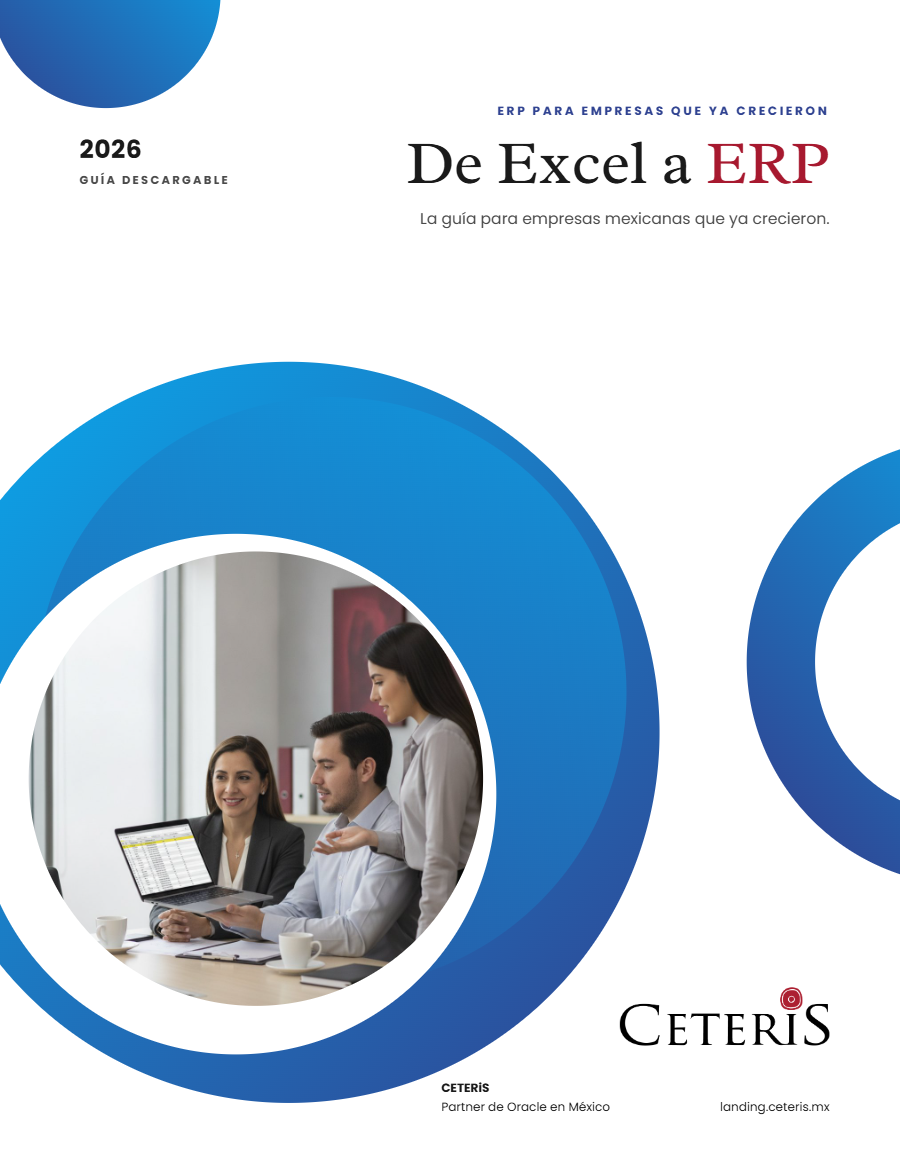
Free guide · 24 pages · In Spanish
From Excel to ERP: how to tell if it's time
What we'd tell you in a first assessment meeting, in writing: how to know whether you need an ERP, what it costs in estimated ranges and how to migrate without disrupting operations. Currently available in Spanish; English edition coming soon.
- The 7 signs you've outgrown spreadsheets
- What an ERP costs and what drives the price
- The 5 most expensive mistakes
- A checklist to decide whether it's time