Mexican Tax Compliance
How to choose an ERP in Mexico: tax requirements and local support
Six tax tests to run in an ERP demo in Mexico, what to ask about the PAC, and how to evaluate local support before you decide.
· 4 min read
A global ERP can be very good and still fail in Mexico on details: a CFDI (Mexican e-invoice) field that doesn't get filled in, a missing complement, a journal entry that doesn't link to its invoice. Those details don't show up in a presentation. They show up when someone tries to invoice on a Monday at nine.
This article proposes six tests to run during the evaluation and four questions to gauge local support. It isn't tax advice: it's meant so your tax team and your accountant can take part with a concrete list.
Why you test instead of just asking
“SAT-compliant” is an easy answer to give and a hard one to verify. (The SAT is Mexico's tax authority.) Oracle's documentation, however, is specific. For NetSuite, it explains that in Mexico taxpayers must use electronic invoicing for all their transactions, that the CFDI follows a format defined by the SAT, and that the Mexico localization generates outbound and inbound documents. Each XML must be certified with the SAT, through an authorized provider (PAC), before it is sent to the customer, and the PAC returns the certified CFDI to the system. It also states that the functionality complies with CFDI version 4.0.
For Oracle Fusion Cloud, the financials guide for the Americas documents Mexico-specific fields that store the CFDI's unique identifier in accounts payable, accounts receivable, expense reports and manual journal entries. In both cases the capability exists. What changes is how it is configured in your operation, and you confirm that with a test.
Six tests for the demo
- Issue a CFDI 4.0 income invoice, with the recipient's complete tax data, through to receiving the certified document. According to the SAT, CFDI 4.0 has been the only valid version since April 1, 2023.
- Invoice a credit sale and record the payment afterward. The SAT requires that when consideration is paid in installments or on a deferred basis, a CFDI with the payment receipt complement be issued for each payment received. Ask to see version 2.0 of the complement.
- Issue a credit note linked to the original invoice and see how it affects accounts receivable.
- Receive a supplier's CFDI and record its tax folio on the purchase invoice, so the journal entry stays linked to the document.
- Generate the electronic accounting filing: the chart of accounts with the SAT's grouping code, the month's trial balance, and journal entries with a reference to the document and payment method, as described in Annex 24 of the Miscellaneous Tax Resolution.
- Ask how the system was updated the last time the SAT changed a format, how long it took, and who did it.
For each test, ask to see the result on screen and the generated file, with your company's data if possible. A screenshot from another customer proves nothing about yours.
Also define who grades each test (finance, tax or IT) and what result counts as a pass before you start. A simple scale of pass, partial and fail, with comments, is enough.
The PAC: who stamps and under what contract
The PAC is a third party authorized by the SAT, and it is almost never discussed in demos. It's worth settling from the start:
- Is the PAC contract signed by your company or by the implementation partner? It changes who pays, who sees the documents and who can switch providers.
- Can you choose a different PAC? For NetSuite, Oracle documents preconfigured integrations with some providers and the option to integrate others that are SAT-certified.
- What limits apply to payment certification? Oracle documents limits on the number of invoices a single certified payment can cover, depending on the configuration. If a customer pays dozens of invoices with one transfer, test that exact case.
Local support: four questions
- When the SAT changes something, who reflects it in your system and within what timeframe: the vendor, the implementation partner or your team?
- In what language, during what hours and in what time zone does support operate?
- Where is your configuration documented? If the person who serves you changes, the knowledge shouldn't change with them.
- Are there customers in Mexico with an operation similar to yours who can provide references?
A local partner doesn't replace the vendor's support. They are different layers, and it's worth asking how they coordinate and who the first point of contact is.
Ask for response times in writing, by case severity. A configuration question is not the same as invoicing being down on a closing day.
What gets forgotten in the evaluation
Four topics show up late and cost a lot: foreign-currency operations and the tax exchange rate, withholdings, handling several legal entities with different RFCs (Mexican taxpayer IDs), and the connection to your banks. Add them to the test list from the start, rather than discovering them during implementation.
How to use this list
Give every option you are considering the same tests, in writing and with the same expected result. It is the fairest way to compare and the one that depends least on who presents best.
If you'd like us to build that test list with you around your company's requirements, tell us which tax obligations weigh on you most today. At www.ceteris.mx/servicios-profesionales/ you can see how we work, or you can schedule a conversation with our team.
Sources
How we can help
Facing something similar?
Tell us which system you run and what it can't do for you today. The first conversation is about understanding your situation.
Request an assessmentMore posts

CFDI 4.0, DIOT and electronic accounting: what an ERP automates and what stays manual

Cloud accounting: when it stops being enough and an ERP comes in

Oracle Integration Cloud: how to connect your ERP to your other systems
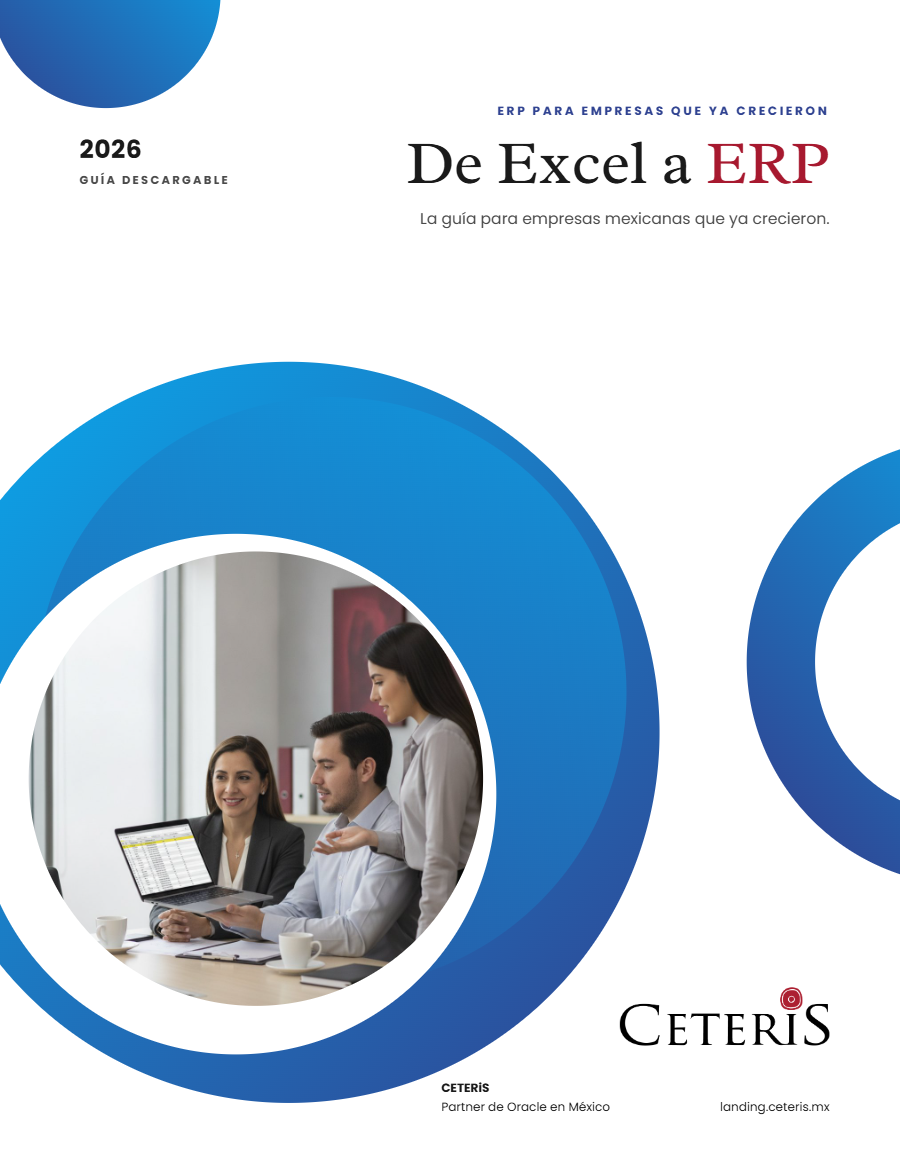
Free guide · 24 pages · In Spanish
From Excel to ERP: how to tell if it's time
What we'd tell you in a first assessment meeting, in writing: how to know whether you need an ERP, what it costs in estimated ranges and how to migrate without disrupting operations. Currently available in Spanish; English edition coming soon.
- The 7 signs you've outgrown spreadsheets
- What an ERP costs and what drives the price
- The 5 most expensive mistakes
- A checklist to decide whether it's time